Moksh Shah
I'm a machine learning engineer with a mathematics minor, moving into quantitative research and trading. For two years I have trained reinforcement learning and computer vision models that fly autonomous aircraft. The work I like best is the modelling: writing down the mathematics, simulating it, and checking whether the data agrees.
Looking for quantitative researcher, trader, analyst and risk roles. B.S. and M.C.S. in computer science with a mathematics minor, University of Illinois Urbana-Champaign.
Research
Five studies in quantitative finance. Each starts from the mathematics, is implemented in Python with tests against known results, and reports what the data showed, including where the model or the strategy fails.
-
Option pricing from first principles, and a Heston calibration to SPY
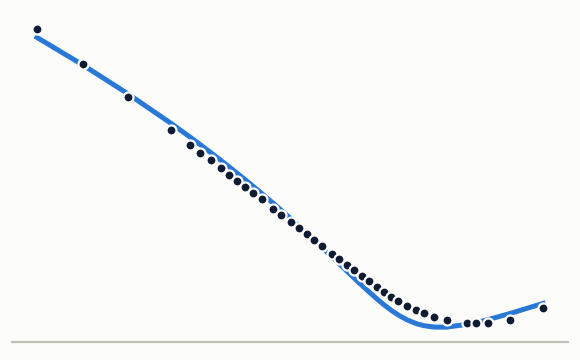
Black-Scholes, binomial tree, finite-difference, Monte Carlo and Fourier pricers written from scratch, each checked against an independent second method, then a Heston calibration to the SPY option chain of 13 November 2026. Five parameters fit 2,295 quotes across 21 expiries to 0.60 implied-vol points, about ten times the bid-ask half-width: a usable description of the surface, and the note shows where its shape is wrong.
Stochastic volatility, COS method, Crank-Nicolson, Longstaff-Schwartz, control variates, put-call-parity forwards, SVI
-
Does cointegration pairs trading survive honest testing?
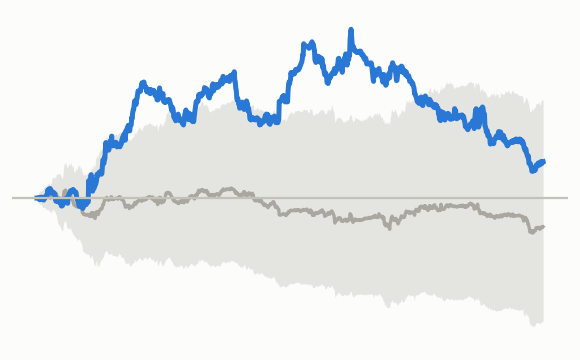
A walk-forward study on 102 US large caps from 2007 to 2026, with costs, a one-day execution lag, false-discovery control across 20,040 cointegration tests, and a placebo of 1,000 random-pair portfolios. After costs the net Sharpe ratio is 0.16, with a confidence interval that spans zero, and the selected pairs do no better than random ones. I report it as it came out.
Engle-Granger cointegration, Benjamini-Hochberg, Ornstein-Uhlenbeck maximum likelihood, stationary bootstrap, deflated Sharpe ratio
-
Which Value-at-Risk model would I run?
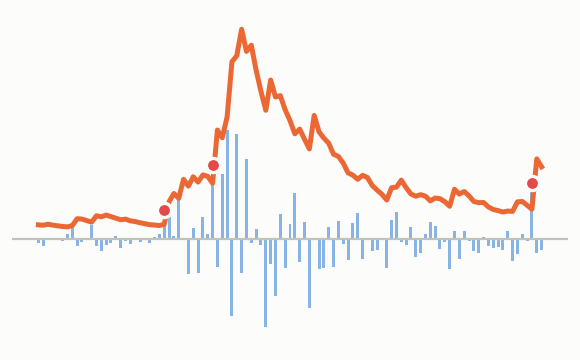
Seven VaR and Expected Shortfall models forecast a multi-asset portfolio's risk on each of 4,781 days from 2007 to 2026, out of sample, and are judged with the backtests a regulator uses. Against 47.8 expected exceedances, conditional EVT had 48 and filtered historical simulation 54; the normal models had about 100. Equities are 55% of the capital and 90% of the expected shortfall.
GARCH likelihoods written from scratch, extreme value theory, Kupiec, Christoffersen and Acerbi-Szekely backtests, Euler risk decomposition
-
Market making under inventory risk
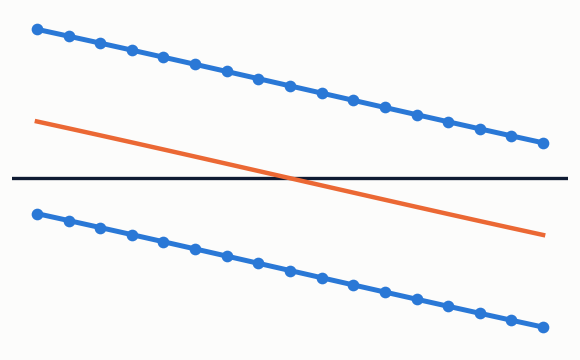
The Avellaneda-Stoikov model derived from its Hamilton-Jacobi-Bellman equation, solved exactly under inventory limits, and simulated over 100,000 sessions. Skewing quotes against inventory halves the standard deviation of P&L (6.5 against 13.3) for 5% less expected profit. The exact solution shows the paper's approximation skews 7.6 times too hard far from the close, and that misjudging how fills decay with distance costs 28 times more than misjudging volatility.
Stochastic control, Hamilton-Jacobi-Bellman equation, matrix-exponential solution of the exact quotes, Monte Carlo simulation
-
Does machine learning beat a three-parameter model at forecasting volatility?
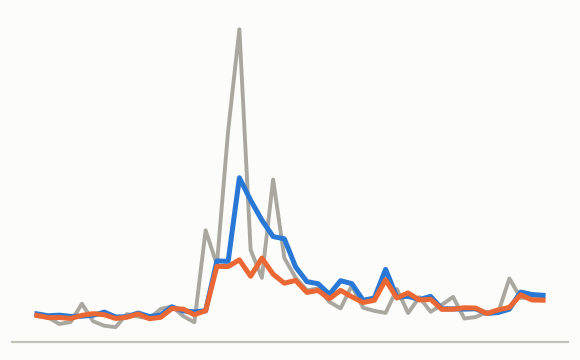
Eleven forecasts, from a random walk to pooled gradient boosting, compared walk-forward on 30 assets over 4,242 days. LightGBM lowers the loss by 9.7% one day ahead, but taking logs in the three-regressor HAR model recovers most of that, and at a one-month horizon boosting is no better than the baseline. In March 2020 the trees could not extrapolate; the linear model could.
HAR, GARCH, LightGBM, range-based variance estimators, QLIKE loss, Diebold-Mariano tests, model confidence set
Background
The short version. Details are on the experience page.
Machine Learning Engineer, Rational CyPhy
Reinforcement learning and computer vision for autonomous aircraft: sequential decisions under uncertainty. Systematic model optimisation raised mission success rates by 65%.
B.S. and M.C.S. in Computer Science, minor in Mathematics
University of Illinois Urbana-Champaign. Bachelor's with High Honors (GPA 3.9), master's GPA 3.8. Coursework in probability and statistics, numerical methods, differential equations, linear algebra, complex variables and differential geometry.
Researcher, Northwestern University
Game theory and computational economics: simulated strategic pricing between competing firms in duopoly markets, and built pricing models to study consumer surplus on ride-sharing platforms.
Get in touch
I'm glad to talk through any of this work, or to be asked hard questions about it. Email mokshcareer067@gmail.com, or find me on LinkedIn and GitHub.